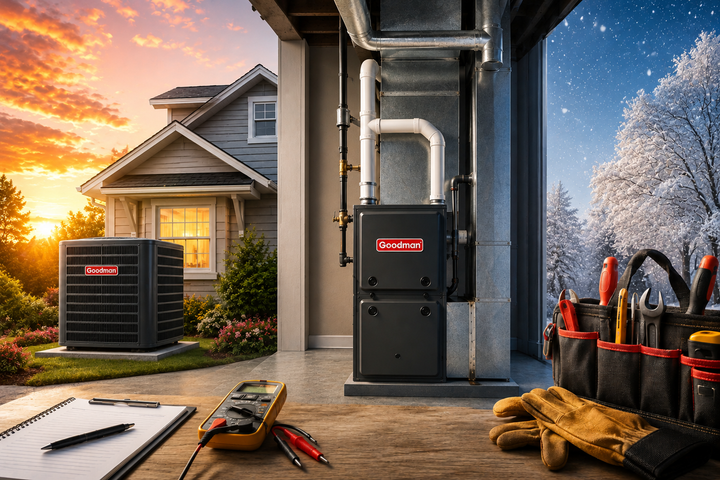
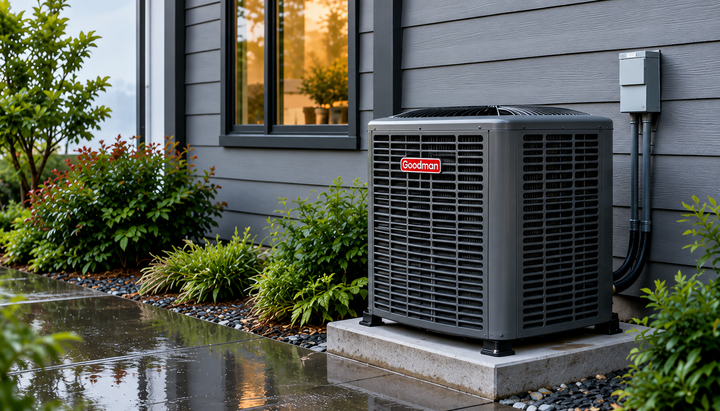
“How long does a furnace last?” is the question most homeowners wish they'd asked the day they signed the install contract, not fourteen years in when the inducer motor fails on a cold morning. The industry averages are easy to find and almost always optimistic. The real answer depends on which piece of equipment you're asking about, which brand is on the cabinet, how the system was installed, and whether anyone has changed the filter in the last six months.
The short version: a gas furnace or electric heater installed well and maintained reasonably lasts 15–20 years. A central air conditioner lasts 10–15. A heat pump splits the difference at 12–15, since it runs year-round. Brand matters less than installation quality, but when all else is equal, Trane and Carrier systems edge out Goodman, York and Lennox on compressor longevity by roughly two years. The two line items that quietly add five years to any system cost about $40 each and almost nobody does them.
What the industry averages actually mean
The Department of Energy and ASHRAE publish lifespan ranges every few years, and most contractor estimates track them closely. The ranges exist because “lifespan” isn't one number — it's the midpoint between “the day the equipment first underperforms” and “the day a repair stops making economic sense.” A furnace that was running fine at year 17 but just failed a heat-exchanger inspection didn't die at year 17. It's been declining since year 12.
Gas furnaces: 15–20 years is the honest range. The limit is the heat exchanger — a steel assembly that cycles from room temperature to 1,000°F every ignition and eventually cracks from thermal fatigue. A furnace with a cracked exchanger is condemned. Everything else in a furnace — igniter, inducer motor, blower, control board — is replaceable without totaling the equipment.
Electric heaters (strip heat, baseboard, air-handler elements): 20–30 years. Resistance elements fail cold, not catastrophically, and replacement is a $200 part most of the time. The air handler housing them typically outlasts the elements.
Central air conditioners: 10–15 years. The compressor is the limiter — it has moving parts, oil, and runs 1,500+ hours per year in most climates. Out-of-warranty compressor replacement costs 30–40% of a full condenser, so most owners replace the whole unit when the compressor goes.
Heat pumps: 12–15 years. Same compressor as an AC, but the heat pump runs 2,500+ hours per year because it covers both heating and cooling. More hours, more wear, shorter life.
Air handlers / coils / blowers: 15–20 years. The sheet-metal cabinet typically outlasts the compressor, so matched systems are often replaced in pieces — new condenser now, new air handler in five years.
Ductwork: 25–40 years if the metal was gauged correctly at install and the joints were sealed. Flex duct and insulation inside degrade faster; the metal plenums and trunk lines usually outlast two generations of equipment.
Those numbers assume reasonable maintenance and competent installation. Both are rarer than contractors admit.
The five factors that compress or extend lifespan

Two identical furnaces installed on the same day in the same neighborhood can be ten years apart at end-of-life. The brand on the cabinet is responsible for roughly one of those ten years. The other nine come from five factors you can read on sight if you know where to look.
1. Installation quality (biggest single factor)
A furnace or AC installed with the correct line-set length, properly brazed under nitrogen, pulled to a 500-micron vacuum and charged by weight will last at the top of its range. The same unit installed with a kinked line set, atmospheric brazing (which oxidizes the inside of the copper), a loose service valve or an estimated charge will fail in the first half of its range. Most early AC failures — compressors burning out at year six, coils leaking at year four — trace back to the install day, not the equipment.
The honest way to check your install was done right: look for the installer's AHRI matched-system certificate, the Manual J load calculation, the pulled permit, and the start-up commissioning sheet with the measured superheat and subcooling numbers. Four pieces of paper. Most homes don't have any of them.
2. Sizing (nearly as important)
An oversized system short-cycles. Short-cycling means a compressor that starts and stops every 4–6 minutes instead of running for 20–30 — the start-up inrush current is where compressors wear out. A 4-ton AC on a house that needs 2.5 tons loses roughly a third of its working life to the extra starts. The furnace equivalent is a 100,000 BTU unit on a house that needs 60,000 — the heat exchanger cycles twice as often and cracks years earlier.
Right-sizing requires a Manual J calculation, which about a quarter of residential installs actually get. The other three-quarters are sized by rule of thumb (“ton per 500 square feet”) which systematically oversizes most newer, better-insulated houses.
3. Maintenance frequency
The two line items that quietly add five years to any system: changing the filter on schedule, and keeping the outdoor condenser coil clean. Both cost about $40 a year combined. Neither requires a service call.
- Filter: 1–3 inch pleated filter every 60–90 days in most houses, or 4–5 inch media filter annually. A clogged filter starves the blower, overheats the heat exchanger in heating mode, and lets the evaporator coil freeze over in cooling mode. The failure modes it causes — cracked exchangers, blower-motor burnout, iced-up coils — are the exact failures that condemn equipment early.
- Outdoor coil: rinse the condenser coil top-down with a garden hose every spring. Grass clippings, cottonwood, pollen and dust mat into the fins and insulate the coil. A coil that can't reject heat forces the compressor to work harder — higher head pressure, higher amp draw, hotter oil, shorter life.
Annual professional tune-ups ($150–$250 for furnace or AC) catch the slow failures — weakening capacitors, developing refrigerant leaks, flame-sensor fouling — before they become $2,000 service calls. Most manufacturer warranties require documented annual service to honor the parts warranty beyond year one; skipping tune-ups can quietly void coverage.
4. Climate and runtime
A heat pump in Minnesota runs more hours per year than a heat pump in North Carolina. A central AC in Phoenix runs more than one in Seattle. More hours means more wear. A rough rule: equipment in the top-10% hottest or coldest climates reaches end-of-life about two years sooner than the industry average; equipment in mild climates lasts about two years longer. Coastal installs lose another two to four years to salt-air corrosion on the outdoor coil unless the condenser was spec'd with a coated coil (worth asking for anywhere within 10 miles of a saltwater coast).
5. Usage patterns
Thermostat setbacks of more than 8°F between day and night force the system to catch up with long, high-load runs that stress components. Running the fan continuously (“Fan: On” instead of “Auto”) adds blower-motor hours without heating or cooling benefit. Setting the AC colder than 70°F in high humidity makes the coil run cold enough to freeze, which stresses the compressor through short-cycling. None of these shortens equipment life dramatically on its own, but combined they can trim two or three years.
Goodman, Lennox, York, Trane and Carrier: real-world lifespan

Industry reliability surveys (Consumer Reports, Puls, Angi) and warranty-claim data from the manufacturers themselves give a reasonably consistent picture of how the five major brands age. The differences are smaller than brand marketing suggests, but they're real and they show up most clearly in the second half of the equipment's life.
Trane
Furnace lifespan 18–22 years, AC lifespan 13–17 years, heat pump 13–16 years. Trane's heavy-gauge heat exchangers on the XC95m and S9V2 gas furnaces and its ClimaTuff compressor on XR and XV condensers test well on long-term reliability. Trane equipment costs 15–25% more than Goodman at purchase, but reaches end-of-life two to three years later on average. Over a 15-year hold, the cost-per-year gap narrows considerably.
Carrier (and Bryant)
Furnace 17–21, AC 13–16, heat pump 12–15. Carrier Infinity-series furnaces and condensers show reliability similar to Trane; the mid-tier Comfort line sits slightly below. Carrier's compressor warranty record is excellent. The common Carrier failure point is the Infinity control board on communicating systems (2012–2018 vintage), which can shorten effective lifespan if the board is unavailable or dealer-sourced at $1,200+.
Lennox
Furnace 16–20, AC 12–16, heat pump 12–15. Lennox Signature Collection equipment has the highest nominal efficiency ratings in the industry (SLP99V furnace, SL28XCV condenser) but lifespan tracks slightly below Trane and Carrier — closer to Goodman and York on average. The limiting factor on Lennox lifespan isn't the hardware; it's parts availability. A Lennox system in a market without a Lennox dealer often reaches “end of economic life” before “end of mechanical life” because repair quotes get held up on dealer-sourced parts.
York (Johnson Controls)
Furnace 16–20, AC 12–15, heat pump 11–14. York Affinity YP9C furnaces and YXV condensers are solid mid-market equipment. Common York end-of-life trigger is the variable-speed blower motor on Affinity furnaces around year 10–12 — a $1,200–$1,800 part that often tips owners toward replacement rather than repair in the second half of the lifespan window.
Goodman (and Amana)
Furnace 15–20, AC 11–15, heat pump 11–14. Goodman equipment is 25–35% cheaper than Trane at purchase and reaches end-of-life one to two years sooner on average. The gap has narrowed considerably since Daikin acquired Goodman in 2012 — current Goodman GMVC96 and GSXC18 units carry Daikin-engineered compressors with reliability closer to the premium brands. Cost-per-year of ownership on a Goodman system is typically competitive with Trane because the lower purchase price compensates for the shorter lifespan.
The honest brand ranking
Ranked purely on average mechanical lifespan at matched installation quality:
- Trane
- Carrier (and Bryant)
- Lennox (penalized by parts availability, not hardware)
- York
- Goodman (and Amana)
The spread between first and last is roughly two to three years — smaller than most brand loyalty suggests. A Goodman system with a Manual J, a pulled permit and annual tune-ups will outlast a Trane system that was oversized and never serviced. Installation is a bigger lever than brand.
Signs the system is nearing end of life
No single symptom means the equipment is finished. Three or more at once usually does.
Energy bills creeping up on a stable house. Heating gas usage up 15% over three winters, or cooling kWh up 20% over three summers, with no change in thermostat habits, is a system losing efficiency. Not a death sentence; often a tune-up finds the cause. Combined with age, it's a replace signal.
Rooms that used to be comfortable aren't. Upstairs runs warm in summer, back bedroom runs cold in winter. Could be ductwork, could be degrading capacity. If it got worse gradually over the last two years, it's probably capacity.
Longer run times for the same temperature. If the AC used to cycle 15 minutes on, 15 off, and now it's running 40 minutes on, 10 off to hold the same setpoint, the compressor is losing capacity — usually from a slow refrigerant leak or valve wear.
More frequent service calls. Three service calls in 24 months on the same system is the equipment telling you it's done. See the repair-vs-replace guide for the arithmetic.
Rust on the heat exchanger or around the burners. Rust is condensation. Condensation on a heat exchanger shortens its life. On a furnace past year 15, surface rust is a sign to budget for replacement in the next 1–2 heating seasons.
Icing on the evaporator coil or outdoor unit (summer). Repeat icing after a filter change and professional service points at a refrigerant leak. Fixing an R-410A leak on a 12-year-old system is often throwing money at a replace decision.
How to add five years to any system
Independent of brand, these five habits consistently extend equipment life by three to seven years. Most cost less than a single service call.
- Change the filter on a schedule. Phone reminder every 60 days for 1-inch filters, every 90 for 2-inch pleated, annually for 4–5 inch media. The $8 filter prevents the $2,000 blower-motor replacement.
- Rinse the outdoor coil every spring. Garden hose, top-down, before the first 80°F day. Takes ten minutes.
- Schedule two tune-ups a year. Furnace in fall, AC in spring. $300–$500 total. Catches the slow failures before they become expensive.
- Clear the condensate drain. Pour a cup of distilled vinegar down the condensate line twice a year. A clogged condensate line is the single most common summer no-cool call and it corrodes the drain pan over time.
- Keep two feet of clearance around the outdoor unit. No shrubs, no fences, no lawn-equipment leaning against the fins. Airflow restriction is the quiet killer of compressors.
None of this is complicated and none of it requires a contractor. A homeowner who does these five things reliably will typically see their equipment reach the top of the industry lifespan range or beyond — regardless of whether it's a Goodman or a Trane.
Planning the replacement before you have to
The worst time to shop for a furnace is during a January cold snap when the heat is off. The worst time to shop for an AC is during an August heat wave. Both situations push owners into whatever a contractor can install this week, which is rarely the best fit on sizing, efficiency, or price.
If your system is in the last three years of its expected lifespan, the quiet months (October for AC, April for furnace) are the right time to:
- Get a Manual J load calculation on the house, independent of any sales quote
- Price two or three replacement options at your target efficiency tier
- Confirm whether a heat pump makes sense now that cold-climate heat pump technology has improved (see the SEER2 guide and R-32/R-454B refrigerant notes)
- Line up financing before you need it
- Decide whether you'll buy the equipment and hire a labor-only installer, or go with a turnkey quote
Equipment ordered on your timeline is 15–25% cheaper than equipment ordered in a panic.
Frequently asked questions
My furnace is 22 years old and still works — should I replace it preemptively? If it works, no part has failed in the last three years, and the heat exchanger passed its last inspection, there's no safety reason to replace. There's a comfort and energy-bill case for replacement — a 22-year-old 80% AFUE furnace costs about 25% more per winter than a current 96% AFUE unit. On fuel prices in most of the country, that difference pays back a replacement over roughly 10 years.
Does running the AC at 68°F shorten its life? Not directly. What shortens its life is the coil freezing when the setpoint is colder than the indoor humidity allows. In a humid house set to 68, the coil can run below dew point and ice up. 72–75°F with the fan on Auto is easier on the compressor than 68 with the fan on On.
I have a Lennox and the nearest Lennox dealer closed. What are my options? Other HVAC contractors can service Lennox equipment; the issue is parts. Non-proprietary consumables (capacitors, contactors, universal motors) can be sourced from any wholesale supplier. Proprietary parts (SureLight boards, iComfort components) still route through Lennox dealers — usually the nearest one, which may be two hours away. Factor that into the repair-vs-replace math as the system ages.
Can a heat pump really last as long as a gas furnace? On a per-year basis, no — a heat pump at 2,500+ runtime hours per year wears faster than a furnace at 800. On a per-hour basis, modern heat pumps match or beat the compressor longevity of equivalent ACs. The lifespan gap is a runtime gap, not a reliability gap.
Is a 10-year-old system considered old? For an air conditioner, yes — it's in the back half of its expected life. For a gas furnace, no — it's roughly at the midpoint. The difference matters when you're deciding whether to put a $2,000 repair into either one.
Does the brand matter more or less than the installer? Less. A top-tier installation of a mid-tier brand will outlast a mid-tier installation of a top-tier brand nearly every time. The order of priority on a new install is: 1) installer, 2) sizing, 3) brand, 4) efficiency tier.
Buying from HVACMORE when it's time to replace
When the arithmetic says replace, HVACMORE carries all five brands discussed above: Goodman, Lennox, York, Trane and Carrier furnaces, matched AC condensers, evaporator coils, heat pumps, and the thermostats and accessories that turn a crated unit into a finished install. Ordering the matched components in one shipment typically saves five to ten days compared to piecing them together from different suppliers.
What ordering from HVACMORE gets you:
- Free shipping on eligible orders over $500, freight and lift-gate service available
- Price match if you find the same model number cheaper elsewhere
- 10-Year Parts Warranty on the systems we sell (manufacturer registration required within 60–90 days of install)
- 60-Day Money Back Guarantee
- 30-Day Hassle-Free Returns with no restocking fees
- Financing and rent-to-own options if you'd rather spread the cost
Not sure which model number matches your existing system footprint, duct connections and electrical panel? Call 855-575-4822 — US-based, Monday to Friday 8am–9pm ET, weekends included. Read the model and serial numbers off your current data plate and we'll tell you the current-year equivalent that drops into the same cabinet opening.
The bottom line
Furnaces last 15–20 years, central ACs 10–15, heat pumps 12–15. Trane and Carrier edge out the field by about two years on compressor longevity, Lennox and York sit in the middle, Goodman is slightly behind on hardware but ahead on cost-per-year because it's cheaper up front. None of that matters as much as installation quality, correct sizing, and whether anyone changes the filter. Spend $40 a year on filters and coil rinses, $300 a year on tune-ups, and almost any brand will reach the top of its lifespan range — while the owners who skip the small items will replace twice in the time you replace once.
Sources
- U.S. Department of Energy — Central Air Conditioning and Furnaces and Boilers (typical service life, efficiency degradation curves)
- ASHRAE Handbook — HVAC Applications, Chapter 37 (service life estimates for residential HVAC equipment)
- Manufacturer owner-support portals (2026) — Goodman, Lennox, York (Johnson Controls), Trane, Carrier (warranty terms, registration windows, maintenance requirements)
- Consumer Reports — reader survey data on brand reliability and service-call frequency for central AC and gas furnace equipment
- ACCA Manual J — residential load calculation methodology referenced by most municipal permit inspectors for sizing requirements
Lifespan ranges in this guide reflect industry averages for well-installed residential equipment in average U.S. climates and are intended as planning references, not warranties of individual system performance. Confirm current warranty status directly with the manufacturer using your serial number before approving any covered-part repair, and schedule a Manual J load calculation before approving a replacement quote.
Ready to upgrade your system?
Free ZIP-based pricing on top-rated HVAC systems
Get instant local pricing and expert help choosing the right AC, furnace, or heat pump for your home.
Shop HVAC Systems