An air conditioner is a fifteen-summer commitment. The unit humming on the pad outside your house today will still be there in 2041, running the same compressor, wired to whatever furnace or air handler you own then, breathing whatever refrigerant is legal to top it off with. That timeline is why the brand you pick, the SEER2 tier you land on, and the tonnage the installer calculates all matter more than the price on the invoice.
The quick answer: the same five brands that dominate the furnace market — Goodman, Lennox, York, Trane, and Carrier — also cover almost every 2026 AC quote. They're all competent equipment. Where they differ is dealer depth, warranty structure, top-end SEER2 ceiling, and how quietly the outdoor condenser runs at 2 a.m. This guide covers how to size an AC to your house, what SEER2 means after the 2023 rule change, why the refrigerant shift matters in 2026, and how the five big brands actually stack up.
Air conditioner vs. heater vs. furnace — the terminology
These three words describe three parts of one system in most American homes:
Heater is the umbrella term for anything that produces heat — a wall unit, a baseboard, a furnace, a heat pump, a boiler. It's a category, not a specific appliance.
Furnace is a specific kind of heater: a forced-air appliance that burns gas, propane, or oil (or uses electric resistance elements) to heat air and blow it through your ductwork. The furnace runs in winter.
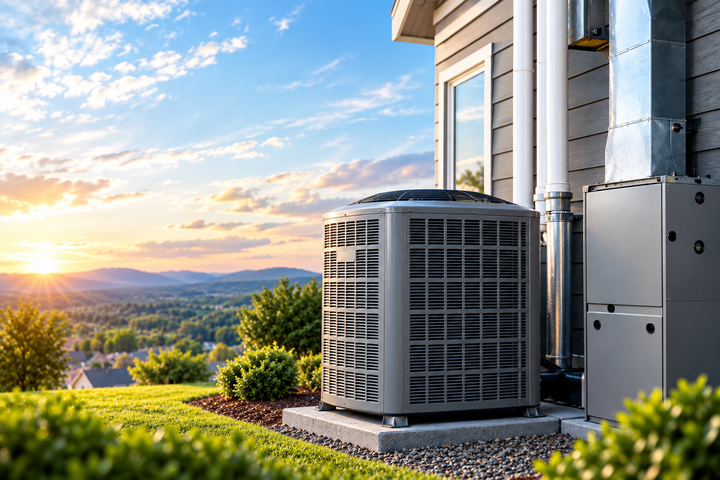
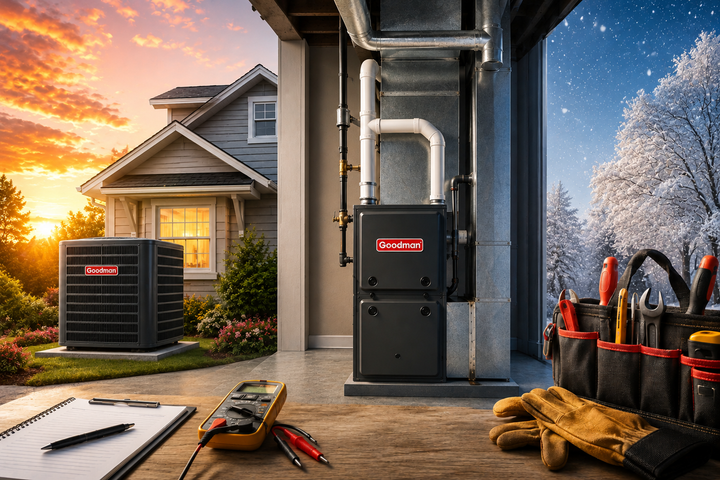
Air conditioner is the cooling side. In a split system, the AC is the outdoor condenser plus an indoor evaporator coil that sits on top of the furnace. The two units share the same blower and the same ductwork. The furnace runs the blower in winter to push warm air; the air conditioner runs the same blower in summer to push cool air. That shared blower is why the furnace and AC are almost always sold as a matched pair — a new AC bolted onto an old, mismatched furnace blower is a service call waiting to happen.
Everything in this guide is about the outdoor AC condenser and its matched indoor coil.
SEER2: what the efficiency number actually means

SEER2 stands for Seasonal Energy Efficiency Ratio 2. It replaced the older SEER rating in January 2023 with tougher lab test conditions that better reflect real-world duct static pressure. The number itself is still watts of cooling per watt of electricity, averaged over a season — a 15 SEER2 AC delivers roughly 15 units of cooling for every unit of electricity it burns.
Federal minimums in 2026 split the country into two regions:
Northern region (roughly north of the 35th parallel). Minimum 13.4 SEER2 for split-system central AC. Cooler summers, shorter cooling seasons, so the payback on higher-efficiency equipment is longer.
Southern & Southwestern regions (Florida, Texas, Arizona, most of the Sun Belt). Minimum 14.3 SEER2 for split-system central AC, and stricter airflow test conditions in the Southwest. Long, hot summers make higher SEER2 pay back faster.
The practical tiers you'll see on quotes:
- 13.4–14.3 SEER2 (entry). Single-stage compressor, meets code, cheapest install. Fine for mild climates or vacation homes.
- 15–16 SEER2 (mid). Where most rebates and most quotes land. Two-stage compressors show up at this tier.
- 17–20 SEER2 (high). Two-stage or inverter compressors, variable-speed indoor blower. Quiet, even, and the sweet spot for Sun Belt long-run cooling.
- 21+ SEER2 (ultra-high). Full inverter modulating compressors. Carrier's Infinity 24 hits 26 SEER2, Lennox's SL28XCV pushes 28 SEER2, Trane's XV20i sits at 22 SEER2. Payback depends heavily on cooling hours per year.
Rule of thumb: in Zones 1–3 (Florida, Texas, Arizona, coastal South) the high tier pays back inside 8 years for anyone staying put. In Zones 5–7 the mid tier is usually the smart stop — the summer isn't long enough to earn back the premium.
Sizing: tonnage, and why bigger is worse

Air conditioners are sold in tons, and a ton is a legacy unit — 12,000 BTU/hr of cooling capacity per ton, dating back to how many BTU it takes to melt a ton of ice in 24 hours. Residential ACs come in half-ton increments from 1.5 tons to 5 tons.
Oversizing an AC is the most common installer mistake in cooling, and it's worse than undersizing. An oversized AC cools the room fast, shuts off, and never runs long enough to strip humidity out of the air. The result: a house that feels cold and clammy, short-cycled equipment that wears its compressor out early, and higher electric bills than a right-sized unit would produce.
The right way to size an AC is a Manual J load calculation — the same ACCA-standard calc used for the furnace, run by the installer with software that accounts for square footage, insulation, window area, orientation, and local design temperature. Any contractor who quotes AC tonnage by walking through the house and eyeballing it is guessing.
Rule-of-thumb starting point (use to sanity-check a Manual J, never to skip one):
- Zones 1–2 (hot South): 1 ton per 500–600 sq ft
- Zone 3 (warm): 1 ton per 550–650 sq ft
- Zone 4 (mixed): 1 ton per 650–750 sq ft
- Zone 5 (cool): 1 ton per 700–800 sq ft
- Zones 6–7 (cold): 1 ton per 800–900 sq ft
A 2,000 sq ft home in Zone 4 lands at roughly 3 tons. In Zone 2 the same home is closer to 3.5–4 tons. Use those numbers as a check; the Manual J is the answer.
The 2026 refrigerant change: R-32 and R-454B replace R-410A
This is the single biggest thing that changed about buying an AC in 2026. As of January 1, 2025, U.S. manufacturers stopped producing residential AC and heat pump equipment charged with R-410A. New units ship with lower-GWP refrigerants — primarily R-32 and R-454B — per the EPA's AIM Act Technology Transitions rule.
What this means in practice:
- Any AC on a 2026 quote uses R-32 or R-454B, not R-410A. Both are mildly flammable (A2L classification) and require slightly different service tools and training.
- An existing R-410A system installed before 2025 is fine — you can keep running it, and R-410A refrigerant is still legal to buy for service until 2036 at the earliest.
- You cannot mix refrigerants. A new R-32 condenser needs a new R-32 indoor coil. Retrofitting a 2020 R-410A coil to a 2026 R-32 condenser is not a thing.
- Brand refrigerant choice varies: Daikin and Goodman are R-32 across the lineup, Carrier and Trane are moving to R-454B, Lennox and York are on R-454B for most 2026 models.
None of this is a reason to rush a replacement of a working AC. It is a reason to make sure the coil and condenser on a new install are matched and use the same refrigerant.
The five major air conditioner brands, compared

Every AC quote in 2026 will lead with one or two of these five names. The engineering differences are smaller than the marketing suggests. The real differences are ownership, dealer network depth, warranty terms, top-end SEER2 ceiling, and price tier.
Goodman
Owned by: Daikin (largest HVAC manufacturer in the world). Positioning: value. Refrigerant: R-32. Top model: GVXC20 (up to 20 SEER2). Warranty: 10-year parts on registered units.
Goodman is the highest-volume residential AC brand in the U.S., and the reason is the same as it is on the furnace side — best $/BTU on the market, backed by a 10-year warranty that matches the premium brands on paper. The equipment underneath is Daikin engineering, and Daikin has been the world leader in inverter compressor technology for two decades. The knock is the same: noise. Mid-tier Goodmans run louder than a comparable Lennox at the same SEER2, and the communicating-thermostat integration is thinner than Carrier or Trane.
Buy a Goodman if you want solid Daikin engineering at value pricing and the badge on the cabinet doesn't matter to you.
Lennox
Owned by: Lennox International (independent). Positioning: premium. Refrigerant: R-454B. Top model: SL28XCV (up to 28 SEER2 — highest in the U.S. market). Warranty: 10-year parts, 10-year compressor.
Lennox owns the top of the SEER2 chart on AC the same way it does on furnaces. The SL28XCV is the highest-SEER2 residential split system sold in the U.S., and Lennox's variable-capacity inverter compressor genuinely edges out Carrier and Trane at the ultra-high tier. Same catch as the furnace side: Lennox is dealer-locked, so parts and service come through authorized Lennox dealers only. In metros with a strong Lennox dealer bench that's fine. In rural markets it can mean longer service waits and less competitive quotes.
Buy a Lennox if you're in a hot climate, staying in the house 10+ years, and there's a reputable Lennox dealer within an hour.
York
Owned by: Johnson Controls. Positioning: mid-market. Refrigerant: R-454B. Top model: Affinity YXV (up to 20 SEER2). Warranty: 10-year parts, 10-year compressor.
York sits between Goodman's value pricing and the premium tier from Lennox, Trane, and Carrier. The Affinity YXV variable-capacity condenser is a genuine premium unit at closer to mid-market pricing, and York's commercial-HVAC parentage under Johnson Controls shows in build quality — the cabinets and coils are heavier-gauge than what Goodman ships. The dealer network is smaller than Carrier's but larger than Lennox's in most metros.
Buy a York if you want premium build quality at mid-market pricing and there's a Johnson Controls dealer nearby.
Trane
Owned by: Trane Technologies. Positioning: premium. Refrigerant: R-454B. Top model: XV20i (up to 22 SEER2). Warranty: 10-year parts, 12-year compressor on select models.
Trane's reputation on air conditioners is what it is on furnaces: reliability. The Climatuff compressors are heavier than most competitors, the outdoor cabinets survive hail and salt-air corrosion better than average, and failure rates in industry surveys are consistently among the lowest. Top-end SEER2 is a hair below Lennox — 22 SEER2 vs Lennox's 28 SEER2 — but the reliability premium is what people are paying for. Dealer network is wide everywhere except deep rural markets.
Buy a Trane if you value long-life equipment over ultra-high efficiency and expect to keep the house 15+ years.
Carrier
Owned by: Carrier Global. Positioning: premium. Refrigerant: R-454B. Top model: Infinity 26 (24VNA6, up to 26 SEER2). Warranty: 10-year parts on registered units.
Carrier invented modern air conditioning — Willis Carrier's 1902 patent is the reason the whole industry exists — and the Infinity 26 remains one of the top three residential ACs on efficiency, tied with Lennox at the modulating-inverter tier. The real Carrier advantage on the AC side is the Infinity communicating thermostat: the outdoor unit, indoor coil, blower, and thermostat all talk to each other, and the system tunes airflow and compressor modulation in a way that produces the quietest, most even cooling in the industry. Dealer network is the largest of the premium brands.
Buy a Carrier if you want the deepest dealer network and tight system integration, and you'll pay premium pricing for it.
Matched systems: the furnace, the coil, and the AC
Almost nobody buys just an AC. The three pieces of the cooling side of your HVAC system all have to be matched:
- Outdoor condenser (the AC unit on the pad outside)
- Indoor evaporator coil (sits on top of the furnace or air handler)
- Blower (part of the furnace or air handler — pushes air across the coil)
If any one of those is wrong, the SEER2 rating on the AC label is fiction. A 20 SEER2 condenser paired with a 12-year-old coil and a fixed-speed blower delivers maybe 14 SEER2 real-world — you paid premium pricing for entry-tier performance.
The two clean scenarios:
- Full system replacement. Replace furnace, coil, and AC together. Matched pair sized correctly, single install, warranties align, rebates stack. This is usually the right call if both units are 12+ years old.
- AC and coil replacement, keep the furnace. Fine if the furnace is under 8 years old. The installer confirms the blower CFM is compatible with the new AC tonnage before quoting. Get the coil model number on the quote.
What doesn't work: replacing just the outdoor condenser and leaving the old indoor coil in place. Refrigerant mismatch (R-410A coil, R-32 or R-454B condenser) makes this impossible on any 2026 install anyway.
What a full AC install actually costs in 2026
Installed pricing varies more by market than by brand. Rough 2026 ranges for a straight AC-and-coil replacement (same tonnage, same location, no ductwork changes) on a 2,000–2,500 sq ft home:
- 14.3 SEER2 entry (Goodman value tier): $4,500–$6,500 installed
- 15–16 SEER2 mid-tier (any brand): $6,500–$9,500 installed
- 17–20 SEER2 high-tier (two-stage or inverter): $9,500–$13,500 installed
- 21+ SEER2 ultra-high (Lennox SL28XCV, Carrier Infinity 26, Trane XV20i): $13,000–$18,000 installed
Full system replacement (AC + coil + furnace + thermostat) at the mid-tier runs $10,000–$16,000 in most metros; at the premium tier, $16,000–$24,000. New line set, electrical upgrades, or pad relocation add on top.
Federal and state incentives take a real bite out of the premium tiers. The ENERGY STAR federal tax credit covers 30% of the cost of qualifying central air conditioners up to $600, and utility rebates in most states stack on top — commonly another $200–$1,000 for a high-SEER2 unit.
The four questions that actually matter at quote time
Get all four in writing from every contractor bidding your job:
1. What Manual J load did you calculate? A real BTU number, not a wave at the square footage. The tonnage you buy should come out of that calc, not out of the installer's truck inventory.
2. What's the matched indoor coil model number, and what refrigerant? The coil model goes on the quote. Refrigerant (R-32 or R-454B) goes on the quote. Both have to match the outdoor condenser exactly.
3. What's the warranty term, and who registers it? The 10-year manufacturer parts warranty only activates on time when the installer registers the equipment — usually within 60 days. Ask who does it, when, and get a copy of the registration confirmation.
4. Is the permit pulled by you or by me? Any AC install requires a mechanical permit in almost every U.S. jurisdiction. The installer pulls it in their name. If they suggest skipping the permit to save $150, hire someone else.
Frequently asked questions
How long does an air conditioner last? A well-maintained residential AC lasts 12–17 years. Skipping annual service knocks that down to 8–10. Coastal salt-air installs and hail-belt installs run shorter than inland ones. The compressor is the most expensive component and usually the first thing to go.
Should I replace my AC and furnace at the same time? If both are 12+ years old, yes. The labor overlaps, the warranties align, the coil and blower are sized to each other from day one, and rebates almost always package furnace + AC together. If your furnace is under 8 years, replace the AC and coil, keep the furnace.
Is a heat pump better than a separate AC? In climates that stay above roughly 20°F most of the winter, a modern heat pump does the same cooling as an AC and replaces the furnace as your heat source, usually at lower operating cost. In genuine cold country, a dual-fuel setup (heat pump for shoulder seasons + gas furnace backup) usually wins.
Which brand has the highest SEER2? Lennox at 28 SEER2 (SL28XCV), Carrier at 26 SEER2 (Infinity 26), and Trane at 22 SEER2 (XV20i). Goodman and York top out at 20 SEER2. Real-world efficiency depends heavily on install quality and matched components, not just the label number.
What's the difference between single-stage, two-stage, and variable-capacity ACs? Single-stage runs at 100% output whenever it's on — cheapest, loudest, worst humidity control. Two-stage has a low fire (~65%) and a high fire, so most of the season it runs quieter and pulls more humidity. Variable-capacity (inverter) modulates continuously from ~25% to 100% based on demand — quietest, most even cooling, highest SEER2, most expensive to buy.
Can I install an AC myself? No. Refrigerant handling requires EPA Section 608 certification, brazing gas connections requires licensed work, and any 2026 install uses a mildly flammable A2L refrigerant (R-32 or R-454B) that's subject to specific handling rules. The permit inspection will fail without a licensed contractor. Unlike a DIY mini split with pre-charged lines, a central AC install is not a homeowner project.
Do I need a variable-speed blower for a high-SEER2 AC? Yes. Above roughly 16 SEER2, the label rating assumes a variable-speed ECM blower in the furnace or air handler. Bolting a 20 SEER2 condenser onto a fixed-speed blower loses about 3–4 SEER2 worth of real-world efficiency and the humidity control that makes high-tier equipment worth the money.
Buying from HVACMORE
HVACMORE carries all five major brands — Goodman, Lennox, York, Trane, and Carrier air conditioners — along with the matched indoor coils, furnaces, thermostats, line sets, and accessories that turn a boxed condenser into a finished install. Ordering the AC, matched coil, and accessories in one shipment means the crew arrives to a complete jobsite instead of a partial one.
What ordering from HVACMORE gets you:
- Free shipping on eligible orders over $500, freight and lift-gate service available
- Price match if you find the same model number cheaper elsewhere
- 10-Year Parts Warranty on the systems we sell (manufacturer registration required)
- 60-Day Money Back Guarantee
- 30-Day Hassle-Free Returns with no restocking fees
- Financing and rent-to-own options if you'd rather spread the cost
Not sure which brand, tonnage, or SEER2 tier fits your home? Call 855-575-4822 — US-based, Monday to Friday 8am–9pm ET, weekends included. Reading a coil model number over the phone before you order takes two minutes and prevents a return.
The bottom line
Between Goodman, Lennox, York, Trane and Carrier, there is no wrong answer on brand — there's a wrong answer on tonnage, on coil matching, and on install quality. Get the Manual J load right, buy the matched AC-plus-coil pair, insist on the permit, and register the warranty on time. A 16 SEER2 mid-tier system installed correctly outlasts a 26 SEER2 premium system installed poorly, every single time. Pick the brand where the local dealer bench is strongest, confirm the refrigerant matches on both pieces, and spend the saved decision energy on the four questions above.
Sources
- U.S. Department of Energy — Central Air Conditioners and Heat Pumps Energy Conservation Program (SEER2 standards, regional minimums)
- EPA — AIM Act Technology Transitions rule (2025 refrigerant transition to R-32 / R-454B)
- ENERGY STAR — Central Air Conditioning (federal tax credit for qualifying units)
- Manufacturer spec sheets and warranty documents (2026) — Goodman, Lennox, York (Johnson Controls), Trane, Carrier
- ACCA Manual J — the residential load calculation standard referenced by most municipal permit inspectors
Model availability, SEER2 ratings, refrigerant options, warranty terms, and rebate amounts vary by region and change year over year. Confirm current specifications with the manufacturer and confirm rebates with your local utility before purchasing. Federal tax credits are subject to IRS rules in effect at time of install.
Ready to upgrade your system?
Free ZIP-based pricing on top-rated HVAC systems
Get instant local pricing and expert help choosing the right AC, furnace, or heat pump for your home.
Shop HVAC Systems