Short version: The blinking LED behind the blower door of a Goodman, Janitrol, or GMC furnace is a numeric fault code. Count the flashes between the 2 to 3 second pauses, match the count to the Goodman flash chart, and order the matched Goodman-Amana OEM part. On a legacy Goodman platform furnace, more than half of the no-heat calls resolve to one of three codes: 3 flashes (pressure switch did not close — usually a blocked condensate drain), 10 flashes (ignition lockout — usually the hot surface ignitor), or 8 flashes (lost flame signal — usually the flame sensor). The complete 1-to-10 chart and the matched real OEM parts stocked at HVACMORE are below.

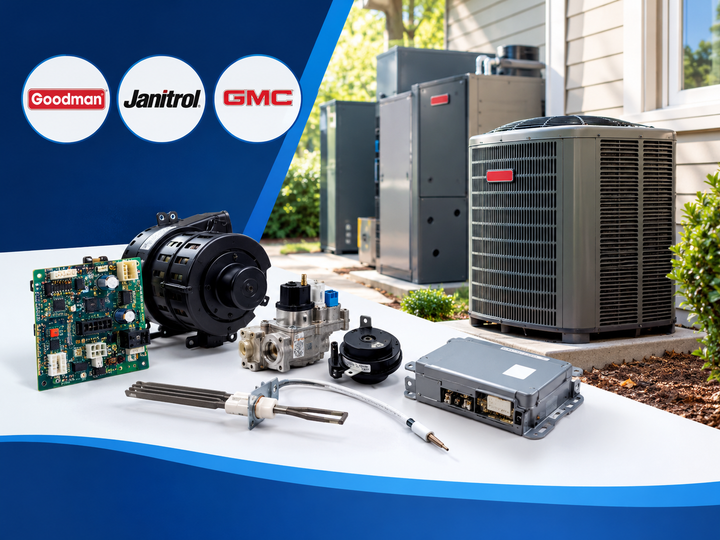
This guide crosses the full Goodman family — Goodman (GMS, GMV, GMPN, GSX cabinets), Janitrol (GMP, GCS), and GMC (early Goodman model prefix) — because all three brands share the same Goodman-Amana PCBBF-series and B1809923S control boards. The flash chart on the inside of the blower door is identical across brand. For the brand-family parts cross-reference, see the Goodman, Janitrol, and GMC Legacy Parts Guide. For related brand-focused flash codes, see the York Furnace Flash Codes Guide.
Where to find the LED and how to count the flashes
On a Goodman, Janitrol, or GMC gas furnace, the diagnostic LED is on the control board inside the blower compartment.
Step 1 — locate the LED. Pull the lower blower-compartment door off the furnace. Let your eyes adjust to the dim light inside. The LED is a single red or green indicator on the control board itself, often visible through a small cutout window in the burner-compartment sheet metal so service techs can read it without pulling panels. On classic Janitrol GMP and early Goodman GMS cabinets, the LED is on the B1809923S circuit board. On 2000s-and-later cabinets, it is on the PCBBF-series board (PCBBF118S, PCBBF124S, PCBBF149S, PCBBF167S).
Step 2 — count the flashes between pauses. The LED flashes in groups separated by a 2 to 3 second pause. Watch two or three complete cycles before you commit to a count. For example: blink-blink-blink…pause…blink-blink-blink…pause is a 3-flash code. A single blink…pause…blink…pause is a 1-flash code. A continuous flutter with no pauses is reverse polarity on the 115V line.
Step 3 — match to the chart. The full 1-to-10 Goodman flash code chart is in the next section. On most Goodman cabinets the chart is also printed on the inside of the blower door — that sticker is authoritative for your specific unit if the chart in this guide and the sticker disagree.
The Goodman furnace flash code chart (1 to 10)
This chart covers the standard Goodman-Amana PCBBF-series control boards and the classic B1809923S installed across Goodman, Janitrol, and GMC gas furnaces from the late 1980s through the mid-2010s. Modulating and communicating boards (GMVC, GMEC, GMVM) use variant schemes — see the FAQ.
Steady on or slow single blink — normal, no fault, no call for heat.
Rapid continuous flutter — reverse polarity on the 115V primary line. Not a part failure; fix the line wiring.
1 flash — internal control board fault. Replace the board.
2 flashes — pressure switch stuck closed. The switch contacts are welded shut when the inducer is off; the board sees pressure before the inducer starts and refuses to run.
3 flashes — pressure switch did not close. The inducer is running but the switch sees no draft — blocked drain (90%+), blocked flue, failed inducer, or disconnected tubing.
4 flashes — open high limit. Heat exchanger over-temperature. Usually low airflow (dirty filter, closed registers, bad blower).
5 flashes — flame rollout or auxiliary limit opened. Rollout switch tripped at the burner area — usually a blocked flue, cracked heat exchanger, or dirty burners.
6 flashes — reverse polarity (variant on some board revisions) or ECM communication fault on newer boards.
7 flashes — gas valve fault. The board commanded the valve open but no gas flow or no 24V feedback.
8 flashes — lost flame signal. Burners lit, flame sensor confirmed, then the signal dropped mid-run (oxidized sensor, dirty flame, intermittent).
9 flashes — auxiliary limit or ECM-related fault (board-revision dependent).
10 flashes — ignition lockout. Three ignition attempts failed. Usually a weak ignitor or a flame sensor that cannot pick up the microamp signal.
The rest of this guide walks each code to its most common root cause and the matched Goodman-Amana OEM part stocked at HVACMORE.
1 flash: internal control board fault — replace the board
A 1-flash code means the control board’s own self-diagnostic has detected an internal fault — a bad relay, a shorted output stage, or corrupted firmware. The board is the fault. Replace with the matched Goodman-Amana OEM number stamped on the old board.


Match the exact Goodman-Amana part number stamped on the old board before ordering. Full control-board lineup is in the Goodman, Janitrol, and GMC Legacy Parts Guide.
2 and 3 flashes: pressure switch problem
Both 2 flashes and 3 flashes point to the pressure switch — the small plastic disc with a rubber hose that confirms the inducer blower is pulling draft before the gas valve opens.
2 flashes — the switch contacts are stuck closed when the inducer is off. The board sees a “draft present” signal before the inducer starts and refuses to run. Replace the switch.
3 flashes — the switch did not close when the inducer started. The inducer is running but the board sees no draft confirmation. Four root causes in order of frequency: (1) blocked condensate drain on a 90%+ condensing furnace — water in the P-trap backs up and raises the pressure in the collector box, keeping the switch open; (2) blocked flue or vent terminal (bird nest, snow, debris); (3) disconnected or split rubber tube between the inducer and the switch; (4) failed inducer motor. Diagnose by pulling the rubber tube off the switch port and sucking lightly on the hose — if the switch clicks (ohmmeter across the contacts shows continuity), the switch is good and the problem is upstream (drain, flue, tube, or inducer).


Match the stamped water-column (WC) rating on the old switch to the Goodman-Amana part — the rating is molded into the plastic housing. If the stamp is a Janitrol- or GMC-era legacy number, call HVACMORE at 855-575-4822 for the current Goodman-Amana supersession.
4 and 5 flashes: limit and rollout switches
4 flashes — open high limit. The high limit switch (typically rated 170 to 200°F) opened because the heat exchanger overheated. Nearly always a low-airflow problem: dirty filter, closed supply registers, undersized return duct, failing blower motor, stuck blower wheel. Clear the airflow issue, let the furnace cool, cycle power. If the limit opens again on good airflow, the switch has drifted or failed — replace with the matched Goodman-Amana auto-reset limit.
5 flashes — flame rollout or auxiliary limit. A rollout switch mounted at the burner bulkhead has tripped. Rollout switches are manually-reset safety devices that detect flame rolling out of the burner area — usually caused by a blocked flue, blocked condensate drain, cracked heat exchanger, or badly dirty burners. Reset the rollout only after you have identified and fixed the root cause. If the switch itself has failed, replace with the matched Goodman-Amana rollout.


Rollout switches are manual-reset safety devices — press the small red button in the center of the switch to reset after confirming the root cause is fixed. If the switch does not reset or will not stay closed on continuity test, replace. Do not jumper a tripped rollout. It is there because the furnace is combusting unsafely.
7 flashes: gas valve fault
Seven flashes means the board commanded the gas valve to open and either did not see the expected feedback or detected a fault at the valve coil. Three failure modes: shorted or open valve coil (resistance measurement across the coil terminals will be zero, infinite, or well outside the 60-80 ohm nominal range), stuck mechanical valve (24V present at the coil but no gas flow), or a wiring problem between the board and the valve.


Shut off the manual gas cock on the inlet line and the service switch before removing the old valve. Match the stamped water-column rating, inlet / outlet size, and stage count (single or 2-stage) to the Goodman-Amana replacement.
8 flashes: lost flame signal — flame sensor
Eight flashes means the burners lit, the flame sensor confirmed, but then the microamp signal dropped during the run and the board shut down for safety. Nearly always an oxidized flame sensor — the rod builds up a thin insulating layer over the years that drops the signal below the board’s minimum (typically 0.8 to 1.0 microamps). Clean with a Scotch-Brite pad as a quick test; if the signal recovers but drops again within a few cycles, replace.


Diagnosis: break the flame sensor wire at the quick-connect, put a multimeter in-line set to DC microamps, call for heat, and watch the reading when flames come up. Healthy signal is 2 to 6 microamps on most Goodman-Amana platforms. Under 1 microamp = lockout threshold.
10 flashes: ignition lockout — hot surface ignitor or direct spark
Ten flashes is the terminal fault code — three ignition attempts failed, so the board stopped trying. Diagnose in order:
Ignitor resistance. With power off, measure across the ignitor terminals. Norton 271N and silicon-nitride mini HSI should read 40 to 90 ohms cold. Infinite reading = cracked ignitor, replace. Low reading (under 30 ohms) = shorted ignitor, also replace.
24V at the gas valve during ignition. Put a meter in VAC mode across the gas valve coil terminals, call for heat, watch during the ~5 second ignition trial. Should see 24-28 VAC with the valve coil energized. 0V = board or wiring issue; 24V with no gas = failed gas valve (go to the 7-flash section).
Flame microamps during trial. Same procedure as the 8-flash diagnosis. If microamps are below 0.8 during a successful trial, the sensor is the culprit even though the ignitor and valve are good.


The 20165703S mini hot surface ignitor is the most-ordered 10-flash fix across the Goodman platform. For the step-by-step chat-style walkthrough, see the Furnace Diagnosis Chat-Style guide.
Worked example: Goodman GMS80703 showing 3 flashes
A homeowner calls about a 2008 Goodman GMS80703 upflow 80% gas furnace in a basement. Thermostat calls, inducer starts and runs, but the gas valve never clicks and the LED flashes a steady 3-flash pattern. The homeowner recently had carpet installed and the furnace area was blocked off with plastic sheeting for a day.
Count. Watch the LED through two full cycles: blink-blink-blink…pause…blink-blink-blink…pause. Confirmed 3 flashes = pressure switch did not close.
Diagnose. Pull the rubber tube off the pressure switch port. Suck lightly on the hose and listen for the switch click. Click is present and ohmmeter across the switch terminals confirms closure. Switch is good. Reconnect the tube and look upstream: the GMS80703 is an 80% unit (not condensing), so no drain trap — check the flue termination outside. The plastic sheeting from the carpet install had folded over the vent cap on the roof during the install day and was never removed. Removing the plastic clears the flue; the inducer immediately builds normal draft, the pressure switch closes, the ignition sequence completes, and the furnace runs.
Part ordered. None — it was a flue blockage, not a part failure. The 3-flash code pointed directly to the right diagnosis in under five minutes.
Why this works. The flash code is a diagnostic shortcut. On an 80% non-condensing unit, 3 flashes rules out condensate drain issues and leaves flue, inducer, tubing, or switch. On a 90%+ condensing unit, the same 3 flashes starts the diagnosis at the condensate drain trap first.

When the flash count doesn’t match the chart
Three cases where the standard chart does not apply.
Pre-2000 B1809913-series boards. Classic Janitrol GMP and early Goodman GMS cabinets with the original B1809913 ignition board use a shorter flash scheme (typically 1 to 5 codes) that doesn’t map 1:1 to the PCBBF-era chart. Read the sticker on the inside of the blower door for the authoritative chart on your specific unit, or replace the board with the current B1809923S supersession to switch to the standard chart.
Modulating / communicating boards (GMVC, GMEC, GMVM). Mid-2010s and newer high-end Goodman cabinets use a 2-digit numeric code displayed on an LCD screen on the control board, not simple flash counts. The codes range from E0 to E9 and 1 through 20+ with distinct meanings — consult the installation manual for your specific GMVC or GMEC model.
Intermittent LED fault. If the pattern changes between watches, the LED driver on the board is likely failing. Replace the board. The flash chart on a dying board is unreliable.
Browsing the full Goodman-Amana catalog
Every part referenced above is at hvacmore.com/collections/goodman, organized by product type: control boards, pilot and ignition, flame sensors, pressure switches, limit switches, gas valves, blower motors, and transformers. If the OEM number stamped on the old part matches a current Goodman-Amana SKU, it ships from the HVACMORE warehouse.
For brand-family parts cross-reference and legacy unit mapping, see the Goodman, Janitrol, and GMC Legacy Parts Guide. For diagnosis walkthrough in chat-style format, see the Furnace Diagnosis Chat-Style guide. For visual control-board diagnosis (burnt traces, swollen capacitors, scorch marks), see the Control Board Visual Diagnosis guide. For York flash codes, see the York Furnace Flash Codes Guide.
Need help identifying a Goodman, Janitrol, or GMC flash code?
If the flash count does not match the chart, if the LED is intermittent, or if the stamped OEM number on the old part is faded, call HVACMORE at 855-575-4822. Have the furnace model number, serial number, control board part number, and a count of the flashes ready. The parts team can look up the exact flash chart that applies to your specific control board and confirm the correct current OEM supersession.
Sources
- Goodman Manufacturing Company — goodmanmfg.com (installation manuals, OEM parts catalog, flash code charts by model)
- Daikin Industries, Ltd. — Daikin corporate (parent company since 2012)
- Amana HVAC — amana-hac.com (post-1997 Goodman subsidiary parts catalog)
- U.S. Department of Energy — Furnaces and Boilers
- U.S. Consumer Product Safety Commission — CPSC.gov (carbon monoxide and gas furnace safety guidance)
- HVACMORE Goodman-Amana parts collection — hvacmore.com/collections/goodman
Prices and part availability pulled from hvacmore.com on 2026-10-23. Pricing and stock subject to change — verify at the linked product page before ordering, or call HVACMORE at 855-575-4822.
Ready to upgrade your system?
Free ZIP-based pricing on top-rated HVAC systems
Get instant local pricing and expert help choosing the right AC, furnace, or heat pump for your home.
Shop HVAC Systems