If you already own an R-410A air conditioner or heat pump, the January 2025 production cutoff does not force you to replace anything. R-410A refrigerant is still legal to produce, sell, and use for servicing existing systems. OEM parts for the installed base are still manufactured. In 2026, the system can be serviced normally — the practical question is how refrigerant pricing, parts availability, and the repair-vs-replace line move over the next five to ten years as production quotas tighten.
The quick answer: virgin R-410A in 2026 runs roughly $8–$14 per pound at the parts-counter level, up from $4–$6 pre-phasedown. Expect gradual increases through 2030, with reclaimed R-410A certified to AHRI Standard 700 taking a larger share after that. OEM parts remain fully available. The service cutoff point for most mid-life systems is still 15–20 years of age or a compressor-level failure, not the refrigerant transition. HVACMORE stocks refrigerant for certified techs, OEM parts for every major brand, and can source replacement R-410A units or A2L replacements. Call 855-575-4822.

Where R-410A refrigerant supply stands in 2026
Three facts frame the current picture:
- R-410A refrigerant is not banned. The EPA Technology Transitions rule under the AIM Act prohibits new residential and light-commercial AC and heat pump equipment using R-410A as of January 1, 2025. It does not ban the refrigerant itself. R-410A continues to be produced, imported under declining quota allowances, reclaimed, and sold for servicing existing systems.
- Production is on a step-down schedule. Under Section (h) of the AIM Act, HFC production and import allowances step down on a declining schedule set by EPA through 2036. R-410A, as an HFC blend of R-32 and R-125, is subject to the overall HFC baseline, not a product-specific ban. The practical effect is a gradually tightening virgin supply, offset over time by growing reclaimed volumes as recovery from retired equipment rises.
- Reclamation is the long-tail supply. The industry is scaling AHRI Standard 700 reclamation operations specifically for R-410A, mirroring the R-22 reclaim market built out after 2010. Reclaimed refrigerant meeting the AHRI 700 purity spec is chemically equivalent to virgin product.
In practical terms for a 2026 service call, R-410A is widely available at HVAC parts distributors. Common sizes are 2 lb canisters, 25 lb jugs, and larger bulk cylinders. HVACMORE sells to EPA Section 608 certified technicians only, with certification verified at order. Pricing varies by cylinder size, allocation, and region. The parts counter at 855-575-4822 quotes current pricing on request.
The R-22 parallel: what the past phase-out tells us about R-410A pricing

The best model for what R-410A pricing and availability will look like over the next decade is R-22. The chemistry is different (R-22 is a single HCFC; R-410A is an HFC blend), but the regulatory arc is nearly identical: new equipment production ends, service refrigerant continues legally, virgin supply declines on a schedule, reclaimed supply fills the gap, prices rise but service remains possible.
R-22 timeline recap:
- 2010 — U.S. manufacturers stopped producing new R-22 residential AC and heat pump equipment under the Montreal Protocol phase-out schedule.
- 2010–2020 — virgin R-22 remained available for service. Prices rose from roughly $4–$6 per pound pre-phase-out to $20–$40 per pound by 2018 as production allocations tightened.
- January 1, 2020 — final U.S. virgin R-22 production and import ended.
- 2020–present — reclaimed R-22 continues to service the installed base. 2026 pricing typically runs $25–$70 per pound depending on cylinder size and purity grade. Supply is tighter but service is still routinely performed.
R-410A projection (modeled on the R-22 parallel):
- 2026 (now) — virgin R-410A widely available, parts-counter pricing roughly $8–$14 per pound for 25 lb cylinders. Modest increases from pre-phasedown baseline.
- 2027–2029 — virgin production and import allowances step down further. Expect pricing to rise toward $15–$25 per pound. Reclamation operations scale to meet service demand.
- 2030–2033 — virgin volumes substantially reduced. Reclaimed R-410A becomes the dominant service refrigerant. Pricing projected in the $25–$45 per pound range, following the R-22 pattern with regional variability.
- 2033 and beyond — primarily reclaimed supply. Service remains possible for the installed base so long as recovered volumes support demand. Follows the R-22 long tail now entering its 15th year.
These projections are directional, not a quote. Actual pricing depends on quota revisions, reclamation capacity growth, raw-material markets for the fluorochemicals, and regional distributor allocation. The point is that R-410A does not disappear in 2026, 2030, or 2035 — it gets steadily more expensive, in a predictable pattern, with a long availability tail that follows the installed-base demand curve down.
OEM parts for R-410A systems: still fully in production
The EPA Technology Transitions rule governs new equipment manufacturing. It does not touch the aftermarket parts channel. In 2026, OEM parts for the R-410A installed base continue to be manufactured and distributed normally:
- Compressors — Copeland (Emerson), Danfoss, Bristol, and ODM-branded replacement scrolls and reciprocating compressors for every major brand.
- Condenser and blower fan motors — ECM, PSC, and X13 motors across horsepower ranges and shaft diameters.
- Thermostatic expansion valves (TXVs) — Sporlan, Danfoss, Parker, and OEM-branded TXVs for R-410A.
- Evaporator and condenser coils — OEM replacement coils remain available for the R-410A installed base across all major brands.
- Control boards, defrost boards, ignition controls — White-Rodgers, Honeywell, ICM, and OEM-branded replacements across every major platform.
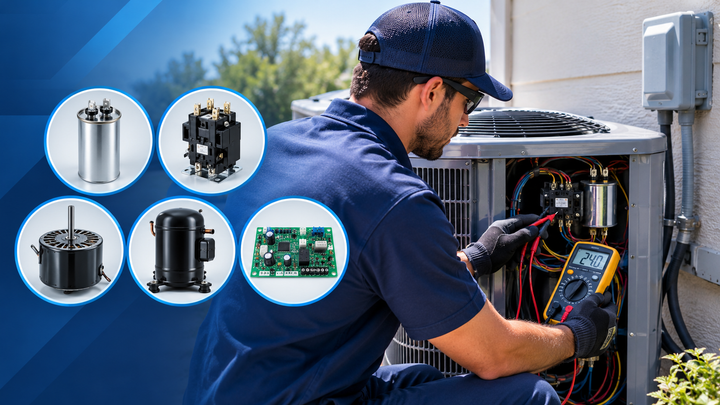
- Dual-run capacitors, contactors, reversing valves, filter driers, fan blades, service valves, Schrader cores and caps — standard aftermarket stock, no R-410A-specific shortage.
HVACMORE stocks OEM and OEM-equivalent parts across York, Carrier, Bryant, Trane, Lennox, Goodman, Amana, Rheem, Ruud, Payne and more. For a parts lookup, call 855-575-4822 with the equipment data plate (model and serial) ready, or browse the HVACMORE OEM parts collection.
Companion guides for diagnosing a system before buying parts:
- AC Diagnosis Chat-Style guide — step-by-step for a no-cool call
- Furnace Diagnosis Chat-Style guide — step-by-step for a no-heat call
- Control Board Visual Diagnosis — visual signatures of failing boards
- York AC Troubleshooting + Model Number Lookup — the model-number-to-parts workflow
Typical R-410A service scenarios in 2026 and what each costs
Below are the five most common service scenarios on an R-410A split system or heat pump in 2026. Costs are directional industry ranges, not HVACMORE quotes, and vary by region, labor rate, and equipment condition. Parts pricing is for HVACMORE OEM retail; call the parts counter for current numbers.
Scenario 1: Low refrigerant, minor leak, top-off and seal
Symptoms: warm air at supply registers, high head pressure or low suction pressure on gauges, suction line not sweating under load, ice on evaporator coil.
Service: electronic leak detection, dye injection if needed, Schrader core or O-ring replacement, 2–4 lb R-410A recharge, pressure test, performance verification.
Expected 2026 cost range: $280–$550 for diagnostic + repair + 2–4 lb of refrigerant. Refrigerant portion is the component rising fastest year over year.
Verdict: routine. No reason not to service.
Scenario 2: Failed dual-run capacitor
Symptoms: condenser fan not spinning, compressor hum without start, humming noise from the outdoor unit, breaker tripping intermittently.
Service: capacitor test (microfarad reading), capacitor replacement, electrical verification.
Expected 2026 cost range: $140–$280 for diagnostic + OEM capacitor + labor. Capacitor itself: $35–$75 retail.
Verdict: routine. Capacitors are consumables; a $60 capacitor saving a $7,000 system is always worth doing.
Scenario 3: Control board failure
Symptoms: flashing fault codes, blower not responding, no 24 V output to contactor, scorched traces or burnt relay visible on the board, system completely dark.
Service: board diagnosis (24 V and line-voltage checks, fault code lookup), OEM board replacement, system reconfiguration if the replacement board requires DIP switch or jumper setup.
Expected 2026 cost range: $380–$780 for diagnostic + OEM board + labor. Board itself: $180–$500 depending on model and brand.
Verdict: favor repair unless the system is also past 15 years with other red flags.
Scenario 4: Evaporator coil leak (formicary corrosion)
Symptoms: repeated refrigerant losses despite leak repairs, pinhole leaks along aluminum coil fins, oil residue on the coil, coil age 8+ years in a humid or coastal climate.
Service: coil replacement, filter drier replacement, line-set evacuation, R-410A recharge (full system charge, typically 6–12 lb depending on tonnage and line-set length).
Expected 2026 cost range: $1,400–$2,800 for OEM evap coil + filter drier + 6–12 lb refrigerant + labor. Refrigerant alone at 2030 projections could add another $150–$450 to this scenario.
Verdict: this is the repair-vs-replace inflection. On a 10–12 year old system, replacement coil is defensible. On a 14+ year old system with the compressor also showing wear, this is often the point where upgrading to an A2L system becomes the better economic choice.
Scenario 5: Compressor failure
Symptoms: no cooling, outdoor unit silent or buzzing without start, compressor hard-locked, acid in the refrigerant circuit after a burnout.
Service: compressor replacement, suction and liquid line filter drier replacement, refrigerant recovery and recharge, oil change, system flush if burnout contamination is present.
Expected 2026 cost range: $2,200–$4,500 for OEM compressor + driers + full refrigerant recharge + labor. On a 2.5–5 ton residential system this is typically 40–70 percent of the cost of a full replacement.
Verdict: on a system older than 12–14 years, replacement almost always wins. On a 6–10 year old system still under some manufacturer parts warranty, the compressor swap is often the right call.
The repair-vs-replace line as R-410A gets scarcer

The industry rule of thumb for repair-vs-replace is the $5,000 rule: multiply the repair cost by the system age, and if the result exceeds $5,000, replace it. A $500 repair on a 10-year-old system is a clear repair ($5,000, borderline). A $800 repair on a 15-year-old system is a clear replace ($12,000). The threshold adjusts for repair severity, prior repair history, SEER2 efficiency gain from a new system, and refrigerant cost over the remaining service life.
For R-410A systems in 2026, the refrigerant-cost factor is becoming meaningful. A 3-ton system holds roughly 7–10 lb of R-410A. If a full-system recharge in 2030 costs $150–$450 in refrigerant alone, and the system is likely to need two or three recharges over its remaining 5–8 years of life, that is a non-trivial addition to the total cost of ownership that did not exist on a pre-phasedown R-410A system.
Rework of the decision framework specifically for R-410A systems in 2026:
- Repair, no question. System age 0–10 years, repair cost under 15 percent of replacement, no history of refrigerant leaks, OEM parts available. Capacitor, contactor, control board, fan motor, Schrader seal, blower wheel, filter drier — routine. Keep it running.
- Repair, with the refrigerant trajectory noted. System age 10–13 years, repair cost 15–35 percent of replacement, no major prior repairs. Mid-range repairs on a system with another 5–8 years of useful life. Factor in future refrigerant pricing over that span, but repair is usually still correct.
- Inflection point. System age 13–15 years, repair cost 35–55 percent of replacement, prior refrigerant leaks or coil work. This is where the R-410A phase-out starts to tip decisions that would have been close calls on a pre-phasedown system. If the repair is evaporator coil or compressor, the refrigerant and the labor to recover and recharge add weight to the replace side.
- Replace. System age 15+ years, repair cost above 55 percent of replacement, major component failure (compressor, coil, both), or a second major leak within two years. On a 15+ year old system, the baseline replacement decision wins regardless of refrigerant, and R-410A phase-out pricing only reinforces it.
Full framework in HVAC Repair vs. Replace 2026, including the SEER2 efficiency-gain math and the useful-life expectation tables.
When replacement is the call: three real paths in 2026
When the repair-vs-replace calculation lands on replace, there are three real paths for an existing R-410A homeowner. The companion R-410A Discontinued guide walks through each in equipment-buyer depth; the summary below is the service-owner view.
Path A: Source a replacement R-410A unit
Appropriate when the indoor coil, line set, and ductwork are still healthy and the owner wants to minimize installation scope. Common with landlords running matched fleets, systems with recently replaced indoor coils, or situations where A2L handling adds complication the owner prefers to avoid. HVACMORE sources remaining R-410A inventory through distributor and new-old-stock channels on a case-by-case basis. Availability is not guaranteed but the parts team can usually check within 24–48 hours. Call 855-575-4822 with the required tonnage, configuration, and preferred brand.
Path B: Replace with an R-32 system
Appropriate for Daikin, Goodman, Amana, or MRCOOL brand preference, or for a full-system changeout where indoor and outdoor are both being updated. Single-component refrigerant, slightly higher capacity per pound than R-410A, GWP of 675. Requires A2L-rated line set (or existing line set flushed per manufacturer spec), A2L service valves, and leak-detection sensors on the indoor unit above the charge threshold.
Path C: Replace with an R-454B system
Appropriate for Carrier, Bryant, York, Lennox, Rheem, Ruud, Trane, or Payne — the legacy R-410A brand ecosystem that chose R-454B for engineering continuity. Operating pressures very close to R-410A, GWP of 466, A2L classification. Same line-set, service-valve, and sensor requirements as R-32.
What a homeowner can do without a Section 608 certification
Refrigerant work — opening the circuit, charging, recovering, replacing TXVs or compressors or coils — requires an EPA Section 608 certified technician. Nothing about that changes with the R-410A phase-out. However, the airflow side of the system is fully homeowner-serviceable, and keeping it in good shape materially extends the useful life of an R-410A system:
- Change the filter on schedule. Every 1–3 months for pleated filters, more often with pets or high occupancy. A clogged filter chokes airflow, drops suction pressure, causes coil icing, and in worst cases triggers compressor short-cycling — the exact failure mode most expensive to fix on an R-410A system in 2026.
- Clear condensate drain lines annually. A plugged drain triggers a safety-switch shutoff on most modern systems and can cause water damage above the air handler. Flush with distilled water or a mild cleaner before the cooling season.
- Clean the outdoor condenser coil. Garden hose from the inside out (power off at the disconnect first), remove debris, keep 2 ft of clearance around the unit. Dirty coils raise head pressure, lower efficiency, and shorten compressor life.
- Verify thermostat operation. Replace batteries if applicable, confirm fan and compressor engage with the expected low-voltage signals. A failed thermostat is often misdiagnosed as a system failure.
- Visual inspection at the outdoor unit. Look for oil residue (refrigerant leak indicator), unusual noises, excessive vibration, burnt wire insulation, scorched contactor contacts. Any of these are a service call — not a DIY fix — but catching them early prevents escalation.
For deeper walk-throughs of the diagnostic process a certified tech runs through, see the AC Diagnosis Chat-Style guide and the HVAC Maintenance 2026 guide.
How HVACMORE supports R-410A service calls
HVACMORE operates four parallel tracks for the R-410A installed base:
Track 1: R-410A refrigerant for certified technicians. 2 lb canisters, 25 lb jugs, and bulk cylinders. EPA Section 608 certification required and verified at order. Current pricing on request — call 855-575-4822.
Track 2: OEM parts for the installed base. Compressors, motors, boards, TXVs, coils, capacitors, contactors, filter driers, reversing valves across York, Carrier, Bryant, Trane, Lennox, Goodman, Amana, Rheem, Ruud, Payne and more. Model-number cross-reference available at the parts counter. Browse the OEM parts collection or call for a lookup.
Track 3: Remaining R-410A equipment sourcing. Case-by-case inquiries through active distributor relationships for homeowners and contractors who need a specific R-410A unit. Common tonnages often sourceable in 1–2 weeks, specialty configurations longer. Information to have ready at the call: current equipment data plate (model, serial, tonnage, refrigerant), required tonnage and configuration, preferred brand, installation timeline, ZIP code.
Track 4: R-32 and R-454B A2L replacements. Full residential lineup across Carrier, Bryant, Payne, Trane, York, Lennox, Rheem, Ruud, Goodman, Amana, Daikin, and MRCOOL for the owner whose repair-vs-replace math has crossed the line. Standard tonnages typically in stock or ship within a week.
Whichever track applies, the first conversation starts the same: 855-575-4822, parts counter staffed Monday–Friday 8am–9pm ET with weekend coverage, with the equipment data plate photo and the reason for the inquiry ready.
Frequently asked questions
Is R-410A refrigerant still available in 2026? Yes. It is still produced, imported under declining quotas, reclaimed, and sold legally for servicing existing systems. HVACMORE stocks it in 2 lb, 25 lb, and bulk cylinders for Section 608 certified technicians.
How much does R-410A refrigerant cost per pound in 2026? Roughly $8–$14 per pound at the parts-counter level for 25 lb cylinders, up from $4–$6 pre-phasedown. Pricing moves with distributor allocation and quota step-downs. Call 855-575-4822 for current numbers.
How long will R-410A be serviceable? At least a decade from today, realistically longer. The R-22 parallel suggests reclaimed R-410A will continue to service the installed base through the useful life of properly maintained equipment, at gradually rising prices.
Are OEM parts for R-410A HVAC equipment still being made? Yes. The phase-out bans new equipment production, not aftermarket parts. Compressors, motors, boards, TXVs, coils, capacitors remain in full production across every major brand.
When does it stop making sense to service an R-410A system? When the next repair plus expected future service exceeds roughly 50 percent of replacement, weighted heavier if the system is past 12–15 years. Compressor and evaporator coil failures on 14+ year systems typically cross the line; most other repairs on mid-life systems still favor repair.
Do I need a certified technician to recharge an R-410A system? Yes. EPA Section 608 certification is required to open, charge, or recover any refrigerant circuit, including R-410A.
Is reclaimed R-410A as good as virgin R-410A? Properly reclaimed R-410A certified to AHRI Standard 700 is chemically equivalent and performs identically. Source only from certified reclaimers.
What causes most R-410A refrigerant losses? Schrader valve or O-ring leaks, formicary corrosion in aluminum evaporator coils (8+ years, humid or coastal climates), and line-set brazing joint failures.
If my R-410A outdoor unit fails but the indoor coil is fine, do I have to switch refrigerants? No. Sourcing a matching R-410A outdoor section is a valid path. HVACMORE inquires about remaining inventory on a case-by-case basis.
What is HVACMORE’s role in servicing R-410A systems? Refrigerant for certified techs, OEM parts for every major brand, sourcing of remaining R-410A equipment, and R-32 / R-454B A2L replacements when it is time. One number — 855-575-4822.
The bottom line
R-410A equipment production ended January 1, 2025 under the EPA Technology Transitions rule, but the refrigerant is not banned and the aftermarket parts channel is not affected. In 2026, servicing an existing R-410A AC or heat pump is routine: parts are stocked, refrigerant is available to certified technicians at parts-counter pricing of roughly $8–$14 per pound for 25 lb cylinders, and the installed base continues to be maintained normally. The R-22 parallel suggests another decade or more of serviceability, with virgin supply gradually replaced by AHRI 700 reclaimed refrigerant and prices rising on a predictable curve. The repair-vs-replace line still tracks system age (15+ years tips toward replacement) and repair severity (compressor and evaporator coil failures on older systems tip harder in 2026 than they did pre-phasedown). HVACMORE supplies refrigerant, OEM parts, remaining R-410A equipment on a case-by-case basis, and R-32 and R-454B A2L replacements. Call 855-575-4822.
Sources
- U.S. Environmental Protection Agency — AIM Act HFC Phasedown (production and import allowance step-down schedule through 2036)
- U.S. Environmental Protection Agency — Technology Transitions Program (700 GWP rule for new residential and light-commercial equipment)
- U.S. Environmental Protection Agency — Section 608 Technician Certification (refrigerant handling certification requirements)
- U.S. Environmental Protection Agency — Section 608 Sales Restriction (certification verification for refrigerant purchase)
- AHRI — AHRI Standard 700 Reclaimed Refrigerant Specification (purity standard for reclaimed R-410A)
- U.S. Department of Energy — Central Air Conditioning (system life expectancy and efficiency guidance)
- Related reading on HVACMORE — R-410A Equipment Discontinued: Replacement Options, HVAC Repair vs. Replace 2026, HVAC Maintenance 2026, Refrigerant Evolution 2026, AC Diagnosis Chat-Style, York AC Troubleshooting + OEM Parts
Refrigerant pricing figures, availability timelines, and the R-22 parallel projections are directional estimates based on EPA AIM Act production step-downs and the historical R-22 phase-out trajectory as of October 2026. Actual pricing moves with distributor allocation, regional supply, quota revisions, and reclamation capacity — confirm current numbers with the HVACMORE parts counter at 855-575-4822 before quoting a customer. Repair-vs-replace thresholds are industry rules of thumb; specific decisions depend on system model, condition, and local labor rates.
Ready to upgrade your system?
Free ZIP-based pricing on top-rated HVAC systems
Get instant local pricing and expert help choosing the right AC, furnace, or heat pump for your home.
Shop HVAC Systems